For the Highly Sensitive, Straight-Presenting, or Questioning—This One’s for You
Target’s “Feathery Friends” Pride Collection, 2025.
Because nothing says queer liberation like plush birds and a moving truck.
It’s Pride 2025. Flags are up, corporations like Target are doing weird shit with bird figurines, and every aisle is trying to sell you queer-coded capitalism. But for many Bi+, pan, questioning, and sensitive folks? Pride feels more complicated than celebratory.
(If you want to see just how weird—think Feathery Friends, $8 beaded bracelets for adults, and lorem ipsum placeholder tags—check out my Substack breakdown. It’s equal parts rage and ridiculousness.)
Especially if you’re not "out loud."
Especially if you're in a straight-presenting relationship.
Especially if you're still figuring it out.
And especially if you're highly sensitive.
The Invisible Closet
If you're in a straight-passing relationship, you've probably felt it—that weird half-in, half-out sensation. People assume. People categorize. And if you don’t perform queerness in a recognizable way, you get overlooked—not just by strangers, but sometimes by your own community.
It’s not just that you were in the closet. It’s that you keep getting shoved back in.
Because the truth is: for many Bi+, pan, fluid, and questioning folks, coming out isn’t a single moment—it’s a loop.
You come out over and over and over again.
At work. At medical appointments. At family dinners. In friend groups. Sometimes in LGBTQ+ spaces. Sometimes to yourself.
And each time, there's a calculation:
Will this be safe? Will I be taken seriously? Will I be seen—or dismissed again?
That cycle wears on you. And it’s not just anecdotal.
According to a 2024 study from the dating app HER, 40% of bisexual people report feeling invisible in LGBTQ+ spaces.
Not straight spaces. Queer spaces.
The ones that are supposed to be safe.
The Cost of Not Belonging
I hear it often from queer clients—especially HSQs (Highly Sensitive Queers), and especially bi+ folks:
“I feel like I don’t belong in LGBTQ+ spaces.”
“I look cis. I feel like a fraud.”
“What if I’m just confused?”
A lot of the anxiety comes from this idea that you haven’t suffered enough to be legit. Especially if you're straight-passing. Especially if you’ve never been harassed, kicked out, or visibly targeted for your queerness. There’s a twisted kind of survivor's guilt—like if the world didn’t hurt you enough, maybe you don’t really belong here.
But even in a world that claims to be “more accepting,” the rules haven’t disappeared. They’ve just gone underground. There are still unspoken checkboxes—expectations to prove your queerness through partners, presentation, politics, or pain.
And it’s not just bi+ folks feeling this. I’ve worked with trans, nonbinary, and genderfluid clients who’ve told me the same thing: I don’t feel queer enough to belong. Sometimes it’s because they chose not to have surgery. Or because they don’t want hormones. Or they present in ways that aren’t “queer-coded” enough to be read by others. When your identity doesn’t fit someone else’s checklist, the pressure to constantly prove yourself shows up fast. That pressure cuts across all our letters—and it’s exhausting.
And over time? That kind of pressure isn’t just stressful—it can be traumatic. It chips away at your sense of safety, connection, and self-trust. It tells you, again and again, that even in so-called “inclusive” spaces, you might still be too much, not enough, or somehow wrong.
The Invisible Closet
If you're in a straight-passing relationship, you've probably felt it—that weird half-in, half-out sensation. People assume. People categorize. And if you don’t perform queerness in a recognizable way, you get overlooked—not just by strangers, but sometimes by your own community.
It’s not just that you were in the closet. It’s that you keep getting shoved back in.
Because the truth is: for many Bi+, pan, fluid, and questioning folks, coming out isn’t a single moment—it’s a loop.
You come out over and over and over again.
At work. At medical appointments. At family dinners. In friend groups. Sometimes in LGBTQ+ spaces. Sometimes to yourself.
And each time, there's a calculation:
Will this be safe? Will I be taken seriously? Will I be seen—or dismissed again?
That cycle wears on you. And it’s not just anecdotal.
According to a 2024 study from the dating app HER, 40% of bisexual people report feeling invisible in LGBTQ+ spaces.
Not straight spaces. Queer spaces.
The ones that are supposed to be safe.
“I went to my company Pride event and they handed out every flag under the sun… except a bi flag”
(And no, that’s not a coincidence. That’s erasure.)
It sends the same tired message: “You’re not really one of us.”
The invisible closet doesn’t have a door you burst through in one dramatic, rainbow-covered moment. It’s made of assumptions. Microaggressions. Silences. Flags that are missing. Questions that don’t get asked. It's the slow bleed of being skipped, side-eyed, or mistaken for an ally in a space where you are the community.
And if you're a Highly Sensitive Queer (HSQ)? That erasure hits like a punch you’re supposed to pretend didn’t land.
You notice the shift in someone’s tone when they find out your partner is a different gender than they expected.
You feel the weird tension when people assume you're “just here in support.”
You hear the joke about being “half-gay” or “confused” and try to laugh it off—but your body clocks it as something else.
You’re not being too sensitive. You’re being impacted.
You’re not whining. You’re navigating an identity that too often gets treated like a phase, a punchline, or a placeholder.
This isn’t about being loud or dramatic.
It’s about the emotional labor of constantly reintroducing yourself in a community that says “we see you”—but too often, doesn’t.
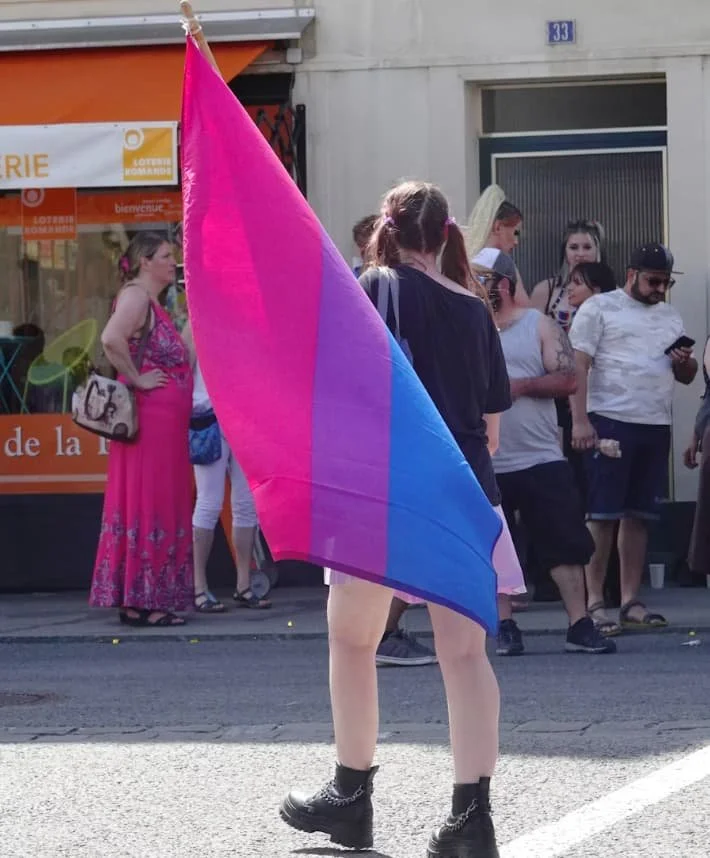
Bi+ identity isn’t always loud—but it’s always real.
Photo by Michal Turkiewicz via Unsplash
The Pressure to Perform Queerness
If you’ve ever asked yourself, "Am I queer enough to be in this space?"—you’re not alone.
I’ve heard it from clients. I’ve heard it from friends. I’ve asked it myself.
Maybe you’re in a “straight-looking” relationship and you get the side-eye at Pride.
Maybe you didn’t come out until adulthood and feel late to the party.
Maybe your attraction is fluid and shifts over time, so you never quite know how to “explain” yourself.
Maybe you’re just tired of explaining anything at all.
In so many queer spaces, there's this unspoken performance pressure:
Be out. Be bold. Be legibly queer. Be political. Be loud enough to prove it.
But what if your queerness is quiet?
What if it’s complex?
What if it just is, and you’re done translating it for other people’s comfort?
That pressure hits especially hard for Highly Sensitive Queers (HSQs). You’re already reading the room, anticipating judgment, scanning for safety. And when your queerness isn’t seen or believed right away? That internal spiral starts fast.
You wonder if you need to dress differently, talk differently, look queerer.
You start editing your language. Overthinking your stories.
You hesitate to correct someone when they assume your partner’s gender—because you don’t want to make it awkward.
This is the emotional toll of not just being queer—but of constantly feeling like you have to earn it.
The Political Pressure on Queer Identity in 2025
Let’s name it: we’re living in a time when identity is being attacked from every angle. Sarah McBride, the first openly trans U.S. Congresswoman, was literally misgendered in a congressional hearing. Lawmakers are openly mocking pronouns. States are banning books, erasing DEI programs, and trying to legislate LGBTQ+ people out of public life.
When the dominant culture is screaming "pick a side" and weaponizing gender identity, it makes sense that claiming a nuanced, fluid identity feels like a risk. Even within our own community, the pressure to be visibly, legibly queer can feel crushing. It’s not enough to be out—you have to prove it.
Struggling with Queer Labels? You’re Not Alone
The whole point of labels is to help us find community and understanding. But for so many bi+, pan, fluid, and questioning folks, labels become another way to feel not enough.
Too gay for the straights.
Too straight for the gays.
Not queer enough.
Not radical enough.
Not political enough.
And for HSPs, that stuff doesn’t bounce off—it burrows in. You replay comments in your head. You overthink your word choices. You hesitate to correct someone who assumes your partner’s gender. You worry that your queerness is always up for debate.
You’re exhausted by your own brain.
Why Highly Sensitive Queer People Struggle More
Highly sensitive people are wired to pick up on subtle cues—facial expressions, tone, micro-reactions. We notice when we’re being left out or dismissed, even when it’s not said out loud.
So when someone raises an eyebrow at your wedding ring, or makes a joke about you being the “token straight person” in the group, your nervous system logs that as a threat.
And if you grew up in a family where emotional safety was spotty at best? Your brain's already primed to believe that belonging is conditional. That you’re too much, not enough, and fundamentally "other."
That’s not drama. That’s trauma.
The Trauma of Erasure for Queer and Sensitive Folks
Complex PTSD doesn't always come from one Big Bad Event. It often comes from a slow drip of invalidation and invisibility.
For many bi+, pan, queer, and questioning people—especially those who are highly sensitive—there's a deep nervous system imprint of not being safe to be yourself.
So what do we do?
We mask. We contort. We over-explain—or we don’t speak at all.
We try to earn our identity by proving our queerness through trauma, relationships, or aesthetics.
We get exhausted from constantly navigating who we can be with whom, where, and when.
And it wears on us.
You Deserve to Exist Without a Disclaimer
Let me be clear:
You don’t need to earn your queer card.
You don’t have to prove anything to anyone.
If you’re Bi+, pan, questioning, or queer in ways that don’t fit neatly into a headline or a hashtag?
Your identity is still real.
If you feel it, it’s yours.
If you know it in your bones but stumble to articulate it? It still counts.
Therapy for Bi+, Questioning, and Highly Sensitive People
This is the stuff I work on with clients all the time:
The quiet, persistent self-doubt
The invisible grief of erasure
The exhausting quest for clarity
The internalized pressure to justify your identity to everyone—including yourself
Therapy can give you space to unpack it without judgment. To question without fear. To practice being fully, unapologetically yourself in a world that constantly asks for proof.
Especially with the world feeling like a damn minefield right now, therapy can be a lifeline.
This isn’t a sales pitch. It’s just true.
Working with a therapist—especially one who gets queerness, invisibility, and sensitivity—can help you:
Reclaim your identity without apology
Build a grounded sense of belonging
Stop contorting yourself to be palatable or “valid”
Feel less alone in all of this
Final Thoughts: You Are Enough
You don’t have to perform your pain to be valid.
You don’t have to erase your joy to be seen.
And you sure as hell don’t need to wait for someone to grant you permission to belong.
You are queer enough. You are real. And your story matters.
Not someday. Right now.
If you've ever asked, "Am I queer enough?" — this is your answer:
You are.
Even if you're still figuring it out.
Even if you're in a relationship that looks "straight."
Even if you feel like you're too sensitive, too quiet, or too late.
You’re not an imposter.
You’re a full human.
Complicated. Beautiful.
And absolutely queer enough.
Want more truth-telling from a therapist who’s still in the trenches?
Join me on Substack for rebellious reflections on therapy, queerness, burnout, and staying awake in a world that wants us numb.
Therapy. Rebellion. Sensitivity. Rage. The stuff polite people avoid—but we don’t.
👉 Come hang out on Substack.
Disclaimer: This blog isn’t therapy. If you’re struggling, please connect with a licensed mental health professional.