The B in LGBTQ
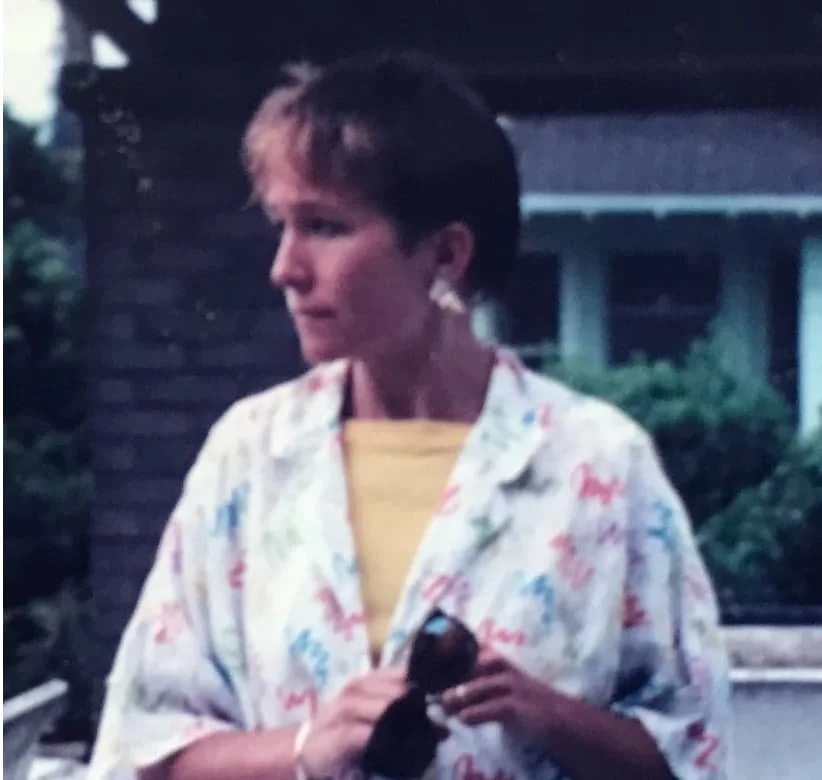
Me, many moons ago in Portland, Oregon, mid-80s. Photo by Kellie Marie Peterson.
A few months ago, I was having dinner and game night with friends at the home of a lesbian couple I've known for a couple of decades. Somewhere between dinner and Boggle, the conversation turned to bisexual women.
My friends had opinions.
Strong ones.
They'd both dated bisexual women. Neither experience had ended particularly well, and neither seemed eager to try it again.
Fair enough. Dating history has a way of creating opinions.
But the conversation moved beyond dating.
They talked about what it had been like to come of age as lesbians in the 80’s, when being visibly gay carried risks it doesn't always carry now. They couldn't pass. Bisexual women could. We could move through the straight world in ways they couldn't without anyone knowing.
And still, I felt myself getting defensive.
Because there was truth in what they were saying. A woman walking down the street holding hands with a man isn't going to be harassed because someone thinks she's queer. A woman holding hands with another woman might be. Being perceived as straight offers safety.
And then, somewhere in the middle of all this, I had an odd thought.
Do they even know I'm bisexual?
We've known each other for twenty years.
They know I'm queer. They know my first long-term adult relationship was with a woman. They know my husband. They know enough of my history that this shouldn't exactly be breaking news.
But I sat there trying to remember whether I'd ever actually said the words.
I'm bisexual.
I hadn't.
And sitting there that night, I felt like I couldn't.
Which was a strange realization to have after twenty years of friendship.
And a surprisingly lonely one.
Finding Home in the Lesbian Community
In my early twenties, I was in my first long-term relationship with a woman and became part of the lesbian community. When we were together, people saw us as a lesbian couple. For the first time, I felt like I'd landed somewhere that felt like home.
And I had.
I wasn't pretending to belong there. I wasn't hiding the fact that I'd been with men before, either. My girlfriend knew. My friends knew. It was simply part of my history.
But I learned that some parts of your history land differently depending on the room.
At one point, she and I joined a therapy group led by a lesbian therapist and author who was well known in the community. Two of us were femme women, both in our first long-term relationships with women after having relationships with men.
One day, the conversation turned to "lipstick lesbians."
I don't remember much of what was said. I remember hoping no one would ask me what I thought.
Not because my history was a secret. Everyone knew.
I just didn't want to have to explain what it meant.
There were other moments like that. Nothing dramatic. It was more subtle than that.
I got good at knowing what would land easily and what might require explanation.
And sometimes, I just didn't feel like explaining.
Bi Erasure: When Other People Decide Who You Are
As my life changed, so did other people's assumptions about me.
When I was with a woman, I was a lesbian. When I was with a man, I was straight.
At least, that's what the world tended to see.
There was something strangely efficient about it. No questions asked. Everyone knew exactly where to put me.
Except neither assumption was quite right.
For a while, I corrected people. Sometimes.
Other times, correcting them meant interrupting a perfectly ordinary conversation to explain something that didn't seem particularly relevant. A story about an old girlfriend became a conversation about my sexuality. Mentioning a boyfriend could somehow erase everything that came before him.
So sometimes I let the assumption stand.
It wasn't a secret. I wasn't ashamed of being bisexual. I was buying groceries. Or talking to another parent. Or telling a story at work.
Not every moment felt like it needed a coming-out scene.
And maybe that's the strange part.
There wasn't one big decision to become less visible. There were hundreds of tiny ones.
So I learned to edit.
A pronoun here. A detail there. Small omissions. Nothing untrue. Just enough to keep the conversation moving without friction.
The Difference Between Being Safe and Being Seen
Sitting at dinner all those years later, I realized my friends and I were talking about two different experiences of the same thing.
They were talking about the ability to disappear.
I was thinking about what it feels like to disappear.
Maybe that's why the dinner stayed with me. I'd spent years assuming my bisexuality was something the people close to me knew. And yet, sitting with friends I'd known for twenty years, I wasn't sure they knew at all.
Or maybe they knew and, somewhere along the way, it had simply faded from view. Either possibility felt strange.
Because I hadn't changed.
I could have stopped the conversation and said, You know you're talking about me, right?
But I didn't.
Their experiences were theirs, and I understood enough of where their feelings came from not to need to challenge them that night.
One of our other friends, a woman in her eighties who has known me for years, was sitting at the table with us. At some point she said, "You know, Tori swings both ways."
She'd said it before. There was a time when the phrase would have embarrassed me, maybe even hurt a little.
That night, it didn't.
Instead, we somehow ended up discussing how much talent it would take to be able to literally bat both ways.
Quite a bit, we decided.
And then we went back to Boggle.
I write about the complicated, funny, painful, and sometimes absurd business of being human. Being a therapist shapes how I see it. Being human shapes it more. This is personal reflection, not therapy.