From the Other Chair: Why I Started Working With Therapists, Doctors, and Other Helpers
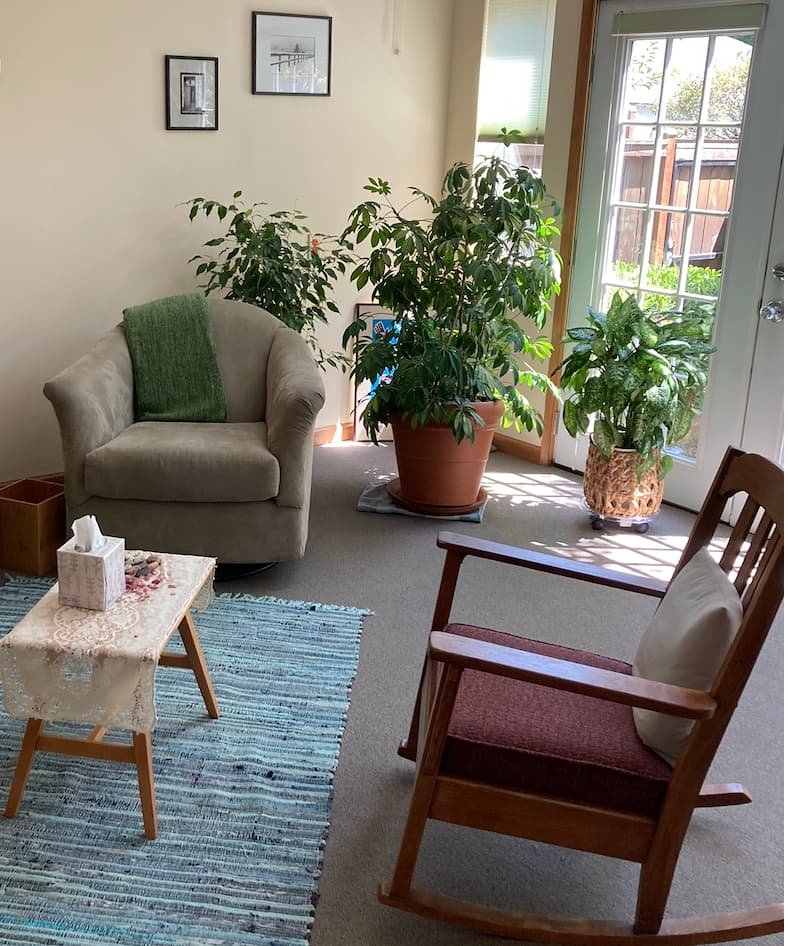
The chairs. Photo by Tori
This is the origin story of why I work with therapists, physicians, attorneys, and other helping professionals. It starts with a bumper sticker and takes the long way around.
The Long Way Around
Sometime around 1989, I was living in Amazon Student Housing in Eugene, going to graduate school and teaching first-year French at the University of Oregon. I wasn't a therapist yet, or even studying to be one. I was working toward a degree in Comparative French Literature. A very useful degree. Obviously.
But I digress.
I had no idea I'd spend the next thirty years as a therapist, or that the work I cared most about would eventually include sitting across from other helpers and healers.
One day I was riding my bike home from school when an old Volvo drove by. I have no idea what color it was, or who was driving, but it had a bumper sticker I've never forgotten:
Think globally. Act locally.
Four words.
Years later, after my own long and winding mental health journey, one that included several years cleaning houses, I knew I wanted to be a therapist, and went back to grad school for a degree in social work. After two years of commuting from Eugene to Portland three times a week, I graduated, landed at a nonprofit, where I spent the next decade and a half.
It wasn’t the most direct route. But it was mine.
What Community Mental Health Taught Me
Working at a low income clinic was a tough job, but rewarding as hell. I loved the fight. People pushing to make their lives better, against odds that weren't fair and systems that weren't built for them.
I heard things. I sat with things.
I knew a teenager who was living with her family in a storage locker. This was years before "tiny living" became an aesthetic. Before people with enough money to choose simplicity started calling it intentional. This was intentional, but of a completely different kind. A family had converted a storage locker into a home and created a separate space just for their daughter. They were working through the shame of where they lived, and how they got there. She went to high school every day and let no one see.
She showered at the school gym, used someone else's internet nearby to do her homework, and was on track to graduate with her class.
No one knew.
But I did.
I worked with families living with generations of trauma. I listened to people caught in systems that were supposed to help them and often didn't, or couldn't. I knew how much need was out there because for years, I heard the stories.
You can't unknow those things.
When I Left and What I Carried
Eventually, I left community mental health.
I left with PTSD.
And in 2013, when I opened my private practice, I felt guilty as fuck.
I knew who wasn't going to be walking through my door. I knew what it meant to be able to find a therapist, make an appointment, have insurance that might only pay for part of it. Or have enough money to pay for it themselves. I knew there were many people who would never have those choices.
And I knew they hadn't stopped needing help just because I’d left.
Private practice felt comfortable in ways community mental health never had. I had control over my schedule. I could decide how many people I saw. I wasn't trying to meet an endless need with resources that were never enough.
And some part of me thought: So this is what you're doing now? After everything you've seen?
It felt like a cop-out.
The strange thing is, I didn't stop caring about any of it when I left. I still cared about poverty. I still cared about trauma that moved through generations of families. I still cared about what happens to people when the systems designed to help them fail. I still cared about access to mental health care and all the people who weren't getting it.
I just couldn't do that work anymore.
Somewhere in those years, I kept coming back to that bumper sticker.
Think globally. Act locally.
I had spent a long time thinking that acting locally meant going where the need was greatest. If I knew people were suffering, and I had the skills to help, wasn't I supposed to be there?
It took me a long time to question that.
Maybe caring about something didn't mean I had to sacrifice myself to it.
And maybe leaving one kind of work didn't mean I had stopped doing the work that mattered.
Helpers Are Terrible at Being Helped
Over time, I started noticing something about the people who found their way to me.
Many of them were helpers.
Therapists, of course. But also doctors, teachers, attorneys, veterinarians. People working in crisis response. People whose jobs required them to notice what other people missed and carry responsibilities most people never saw. Different professions, different lives. But I recognized something in all of them.
They gave a shit.
They cared about doing their work well. They cared about the people who depended on them. And almost every single one of them had a very hard time figuring out where their responsibility ended.
Some were exhausted. Some were burned out. Some were still functioning beautifully from the outside while privately wondering how much longer they could keep doing it.
And almost universally, they felt guilty about needing anything themselves.
When you're used to being the person other people turn to, becoming the person who needs something can feel like a betrayal of your own identity. Helpers are good at helping. We're not always so good at being helped.
Therapists can be especially terrible at it. We know the language. We know the theories. We can analyze the hell out of ourselves. We can sit in therapy and still find a way to take care of our therapist, worrying whether we're being a good client, whether we're taking up too much space, whether what we're bringing into the room is too much.
I tell my clients: you don't have to make this easier for me. You don't have to figure out what you need before you get here. You don't have to be good at this.
For this hour, you get to be the one who needs something.
One Healer at a Time
It took me a long time to see my private practice differently.
I hadn't stopped caring about the people I'd worked with in community mental health. I hadn't stopped caring about poverty, trauma, access to care, or the systems that failed people. I still haven't.
But over time I began to understand something about the people sitting across from me.
They weren't just people who needed help.
They were people who were going back out into the world and helping other people.
The therapist I worked with was going back to her clients. The teacher was going back to her students. The exhausted resident was going back to her patients at the VA. The attorney was going back to the people who depended on her. The person working in crisis response was going back to a job where somebody else's worst day might be an ordinary Tuesday.
Taking care of the people who take care of other people matters.
Not because their needs matter more. They don't.
But because helpers are human beings too. They get overwhelmed. They burn out. They carry things home. They question whether they're doing enough. And sometimes they need someone else to sit with the things they know.
Somewhere along the way, I started thinking again about that old Volvo.
Think globally. Act locally.
I'd spent years thinking that making a difference meant being where the need was greatest. Maybe I'd misunderstood what acting locally could look like.
I can still care about the bigger picture. I can care about poverty and inequity and broken systems. I can vote and advocate and speak up. I can write. I can know what I know and refuse to look away.
And I can do the work that's right in front of me.
One healer at a time.
I write about the complicated, funny, painful, and sometimes absurd business of being human. Being a therapist shapes how I see it. Being human shapes it more. This is personal reflection, not therapy.