Charlie Kirk Is Dead. What Do We Do With That?
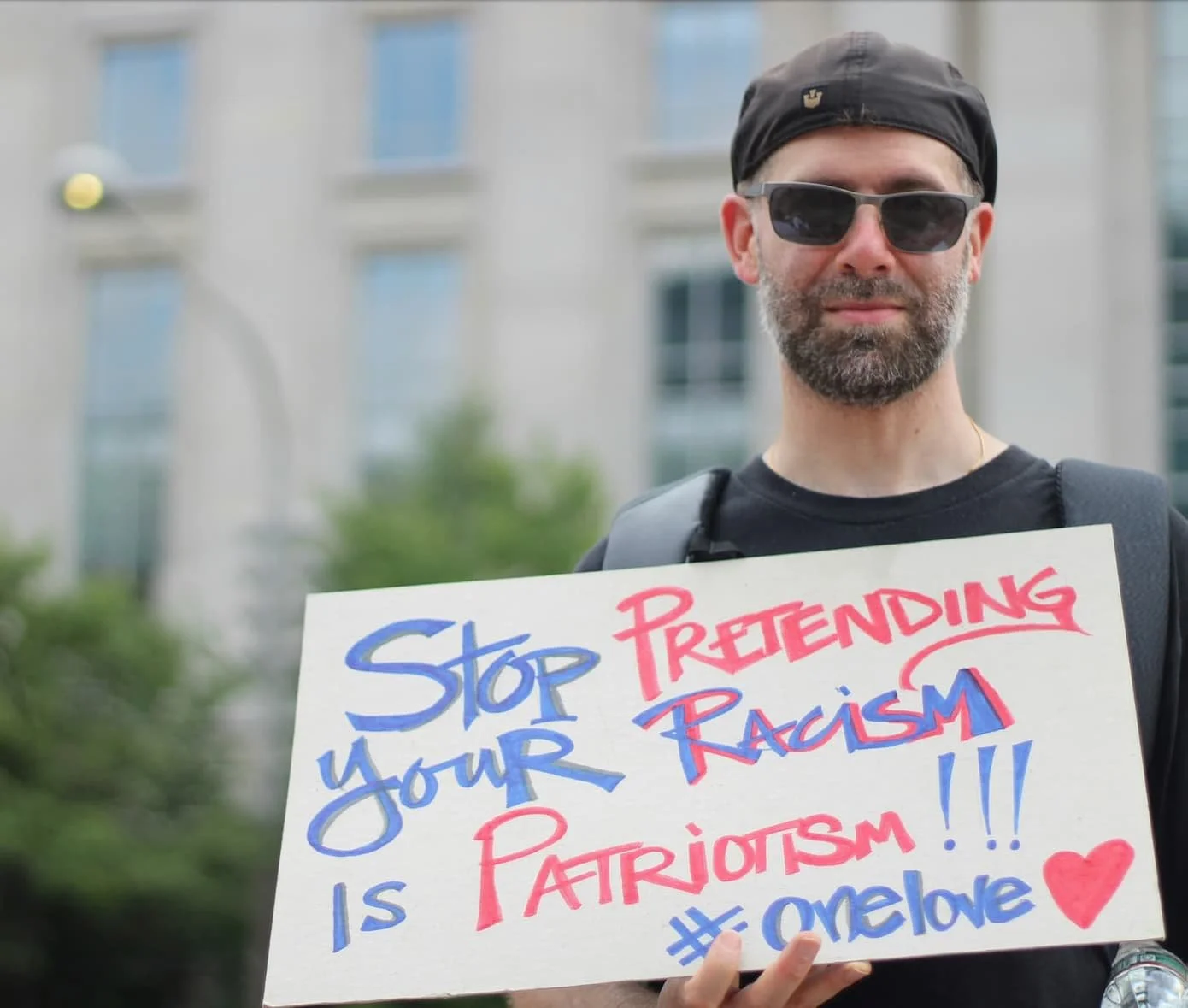
Stop Pretending Your Racism is Patriotism sign at a protest. Photo by Melany Rochester/Unsplash
Another shooting. Another headline. Charlie Kirk shot dead.
The reactions poured in before the body was cold: shock, grief, celebration, confusion, denial. Some rushed to canonize him as a “patriot.” Others said “good riddance.” And a whole lot of people just felt…nothing.
If you’re sitting in that messy middle — feeling compassion for his children, relief that his voice is gone, anger at the inevitable whitewashing — you’re not alone.
Both Things Can Be True: Grief, Anger, and Mixed Feelings About Charlie Kirk’s Death
We can condemn political violence and this hideous murder while also condemning Charlie Kirk for the rotten, vile hatred he fomented.
It doesn’t have to be either/or. We can recognize the grief and accept its reality — even if we don’t understand it, and even if we don’t feel it ourselves — maintain basic civil decency for his grieving family, and still be honest about the deeply harmful, offensive things he said and the divisions he stoked.
This is what makes it so complicated. Trauma survivors know this terrain: you can love and hate someone at the same time. You can long for approval and rage at the harm. Children of abusive parents often grieve their loss and feel relief that the cycle is over. Those contradictions don’t cancel each other out. They’re part of being human.
The Harm We Can’t Gloss Over: Charlie Kirk’s Racism, Misogyny, and Anti-LGBTQ Rhetoric
On Race and Affirmative Action
Charlie Kirk wasn’t just some generic conservative “commentator.” He built his empire on tearing people down.
He sneered at Black women leaders — Joy Reid, Michelle Obama, Justice Ketanji Brown Jackson, and Rep. Sheila Jackson Lee — saying they “do not have the brain processing power to otherwise be taken seriously” without affirmative action. In his words, they “had to steal a white person’s slot.”
Let’s sit with that for a moment. Charlie Kirk said some of the most brilliant, accomplished Black women in America “do not have brain processing power.” And this is the man for whom Trump lowered the flag to half-mast.
It didn’t stop there. He called Martin Luther King, Jr. “awful” and “not a good person,” and insisted America “made a huge mistake when we passed the Civil Rights Act in the 1960s.”
On race and opportunity, he spewed: “If I see a Black pilot, I’m going to be like, ‘Boy, I hope he’s qualified.’” That is not just a bad joke — that’s deeply racist garbage that undermines every Black professional working twice as hard to prove their worth in a country built to doubt them.
That’s not just an insult — it’s an assault on every one of us.
On Gender and Feminism
On gender and reproductive rights, he made it simple: women should “submit.”
He flat-out told Taylor Swift: “Reject feminism. Submit to your husband, Taylor. You’re not in charge,” when talking about her engagement to Travis Kelce.
On LGBTQ+ Rights and Trans Care
Kirk’s hatred wasn’t limited to race or women. He branded gay and transgender people “groomers” who are “destructive,” opposed gay marriage, and campaigned against gender-affirming care for trans youth, declaring: “We must ban trans-affirming care — the entire country. Donald Trump needs to run on this issue.”
Which Trump did.
On Islam and Empathy
Kirk also fomented paranoid, Islamophobic nonsense, calling Islam “the sword the Left is using to slit the throat of America.”
And then there’s this: he even dismissed empathy itself.
“I can’t stand the word empathy. I think empathy is a made-up, new age term, and it does a lot of damage.”
Think about that. The very idea of understanding or feeling with other people — he painted as dangerous. That’s not just conservative politics. That’s dehumanization at its core. It’s a worldview that says compassion is weakness, and cruelty is strength.
For those of us who are highly sensitive, who feel the weight of cruelty more intensely, it’s no wonder his rhetoric landed like poison.
This is who he was. This is the record. And this is why pretending he was simply a “victim of political violence” does more harm than good.
The Blame Game: Political Violence and the Left-Right Narrative
Within hours, Rep. Nancy Mace and Donald Trump were blaming “left-wing lunatics.” But let’s be honest: these are not the people who are going to lead us out of this toxic pit. They, along with Charlie Kirk, are the ones who dug it deeper.
Kirk became a wealthy influencer by spreading toxic rage, fear, and paranoia. He weaponized his platform to attack women, people of color, immigrants, LGBTQ+ people, Muslims. That is not leadership; that is gasoline on the fire.
Instead of reckoning with the violence, leaders doubled down on division — the same playbook Kirk himself used for years.
Who Gets Attention, Who Gets Erased
Within minutes of Kirk’s shooting, there was a school shooting at Evergreen High School. Barely a blip in the news cycle.
Think about that: whose life is treated as more valuable? The man who screamed that a few shootings a year are just the “cost of the Second Amendment”? Or the kids who went to school to learn about history — and ended up as a footnote in the history of our country, simply because they showed up that day.
This is how abuse works, too. Abusers make the most noise. They dominate the room. They’re treated as “important.”Meanwhile, the harmed get small, quiet, invisible. They’re told they don’t matter — and eventually, they start to believe it.
“I don’t support what happened to Charlie. But Charlie supported what happened to Charlie.”
What Charlie Kirk Profited From: The Rage Economy
Charlie Kirk helped create the toxic stew we’re drowning in now. He didn’t just participate in the rage economy — he helped build it. He made millions off of fear and division, and he reveled in being loud, obnoxious, and cruel.
He turned hate into clicks, paranoia into donations, and division into a speaking career. That’s the business model: the louder the outrage, the bigger the platform.
So yes, respect the grief of his family and followers. But don’t sanitize his legacy. Because this is precisely the moment to remind people what he stood for, what he profited from, and what kind of poison he poured into our national bloodstream.
Words Matter: Stochastic Terrorism and Political Violence
Charlie Kirk didn’t just “debate.” He practiced a form of stochastic terrorism — pumping out endless streams of rage, fear, and eliminationist rhetoric while keeping his own hands clean. That’s how plausible deniability works: you say you’re “just asking questions,” “just exercising free speech,” “just engaging in debate.” But statistically, some percentage of followers take those words as a call to act.
When I first learned the definition of stochastic terrorism, it just about knocked me over. I’d never heard the term until recently, when someone named exactly the kind of “discourse” Kirk thrived on. And suddenly the gaslighting made sense — it’s not just ugly talk, it’s a strategy.
He built his career on hatred disguised as Christianity, violence disguised as patriotism, and elimination rhetoric dressed up as “free speech.” That’s not neutral. That’s not harmless. Words set nervous systems on fire. They plant seeds of suspicion, paranoia, and rage. And eventually, someone acts them out.
Experts have warned that the assassination of Charlie Kirk marks a watershed moment in a vicious spiral of political violence in America, underscoring how rhetoric feeds real-world harm. (Reuters)
And the public sees it too: a recent poll found that around two-thirds of Americans believe harsh political rhetoric contributes a lot to political violence. (Reuters/Ipsos)
Here’s why naming this matters. In mental health, a diagnosis isn’t meant to demean — it’s a definition. It helps make sense of deep, overwhelming feelings that can make us feel “crazy.” In the same way, having a term like stochastic terrorism helps make sense of what’s happening. It explains the gaslighting: the speech doesn’t directly command violence, but it creates the climate for it, then hides behind “plausible deniability.”
Definition: Stochastic terrorism uses public rhetoric, typically in mass media, to provoke statistically predictable but individually unpredictable acts of violence from a “lone wolf” perpetrator. In this cause-and-effect relationship, the hateful or hostile speech is the cause, while the subsequent violent act is the effect. The speech does not directly command violence but creates a hostile climate or reinforces an ideology that inspires someone to act, providing the instigator with cover when violence erupts.
Words matter. They always have. And Kirk knew exactly how to use them.
Mixed Feelings Are Human: A Therapy Perspective on Grief and Contradictory Emotions
Here’s the therapy angle: it’s okay to feel complicated about this. It’s okay if you don’t feel sad. It’s okay if you feel numb. It’s okay if you feel relief.
Grief doesn’t always show up the way society tells us it should. Sometimes compassion for a family exists right alongside anger at the harm someone caused. Sometimes there’s no grief at all, just a wish that the cycle of violence — shootings, rage, whitewashing — would end.
And then can come the shame spiral: Am I a bad person if I feel relief? Am I heartless if I don’t feel grief? What’s wrong with me? Nothing is wrong with you. Those contradictions don’t mean you’re broken — they mean you’re human.
Mixed feelings are a hallmark of trauma. Survivors often carry love and hate for the same person. That complexity doesn’t disappear when the person dies. If anything, it sharpens.
The work — in therapy and in life — is learning to hold those contradictions without letting them destroy you. To say: yes, I feel both anger and compassion. Yes, I feel both numbness and rage. Yes, I feel both relief and sorrow.
When feelings collide, the nervous system wants resolution. But sometimes the most rebellious thing we can do is tolerate the mess. Refuse to be gaslit into one “correct” response. Stay human even when the world demands a tidy script.
So if your reaction to Charlie Kirk’s death is complicated, or not what you think it “should” be, let that be okay. Coping with conflicting emotions doesn’t make you weak — it makes you human. Your feelings don’t need to be tidy, and they sure as hell don’t need to pass a respectability test.
Disclaimer: Reading this blog isn’t the same as therapy. If you’re struggling, please reach out to a licensed mental health professional — you don’t have to do this alone.