My Father Fought Fascists. My Brother Voted for One
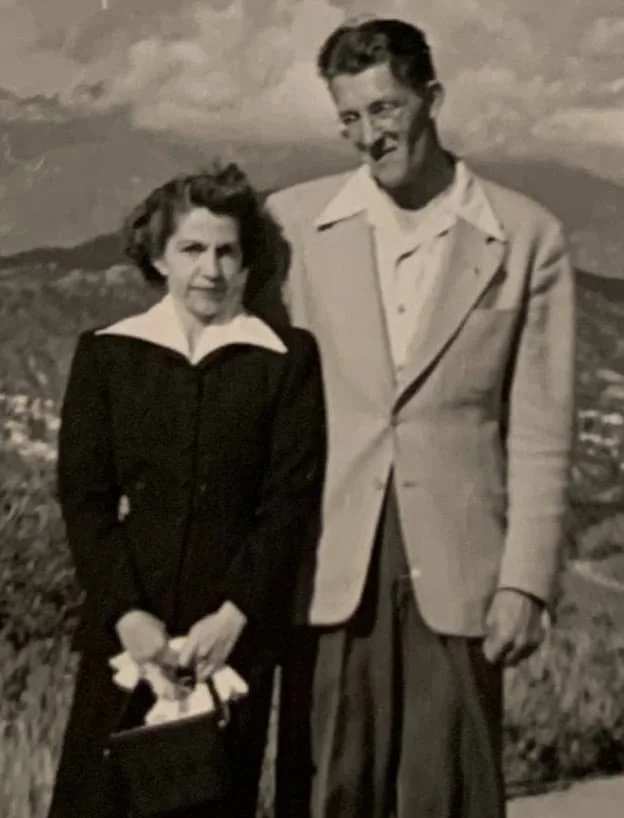
My parents, early on
I love my brother.
I just don't know if I like him.
We were raised by the same parents.
Not in the same circumstances.
Not by the same version of them.
To really understand how the two of us could grow up in the same family and end up believing they're living in different Americas, you have to understand the people who raised us.
The Immigrant and the War Years
My dad was an immigrant. Today, people on the same political spectrum as my older brother might shove him to the side with two words: illegal alien.
The truth is, like with many immigrants, he worked hard, and built a life in the States. Without him, none of us would exist.
In 1921, his German-born mother left her husband in rural Canada, and came to Los Angeles with two young boys. She turned their house into a boarding house to survive, and by thirteen my dad was throwing papers for the Los Angeles Times to help support the family.
On his first day of high school he showed up wearing knickers, something that was perfectly normal where he'd come from, but was humiliating in Los Angeles.
He never forgot what it felt like to be the outsider.
After working his ass off for years, he became a citizen in 1937, then was drafted during World War II.
While he served, my mom rented rooms to women whose husbands were overseas. She rationed food, made rabbit stew with vegetables from the victory garden, saved metal scraps for the troops, and went without. She did what needed doing.
My Mother’s America
My mom grew up in Ponca City, Oklahoma, in a big Irish Catholic family at a time when the Klan had real power.
Her father's store was burned to the ground when she was young. She used to tell a story about sitting next to him in a wagon and he pointed out a family she wasn't supposed to visit, even though she knew the little girls.
Not long afterward, he died from cancer, leaving her mother to raise ten children alone.
Early on, she learned how to read a room. Who was safe, who wasn't, what could be said out loud, and what had to stay quiet.
There wasn't much money.
But there was music.
At family gatherings, they pushed furniture to the side, fiddles came out, and the grown-ups danced late into the night. The little kids fell asleep on piles of coats in the corner.
Joy, grief, and fear about the future lived side by side in the same house.
As a teenager, she'd sneak across town to hear live bands and dance, even when she wasn't supposed to be there. Years later, she still used words she'd learned as a child.
Words that truly made my stomach turn.
Looking back, I think she spent her whole life trying to balance the world she grew up in with the one she wanted to build.
People can be complicated like that.
Later in her life, she quietly welcomed people others looked down on. She also carried prejudices she never questioned.
Both things were true.
That complexity is part of what I've had to make peace with.
From Brentwood to Pico Boulevard
My parents married in their twenties and, little by little, worked their way up—from a modest house in Los Angeles to one in Brentwood.
Then my dad got sick, and everything they'd spent years building unraveled. They sold the house and bought the Holiday Motel, a run-down place on Pico Boulevard and 11th, thinking they could turn it into a nice little place close to the beach.
It didn’t work. It was always the kind of place you wouldn't brag about owning.
Or living in.
My oldest siblings remembered Brentwood. The three youngest of us never knew it.
Same parents.
Different childhoods.
At the motel, the carpet was worn, and the rooms smelled like old stale smoke. Tenants paid by the week if they could, by the day if they couldn't.
Some paid by the hour.
Looking back, I don't know how the move changed who my parents were. What I do know is that it changed who and what they saw every day.
The people who came to the office window weren't lawyers or executives. They were families trying to hang on. Old men. New immigrants. People who lived one missed paycheck away from losing everything.
Different Versions of the Same Parents
The truth is, my older siblings grew up with different parents. They got the war years. The ration books, the scrap drives, and the young mother who rented rooms to women who worked in factories, and whose husbands were fighting overseas.
I was just a toddler when we moved down the socioeconomic ladder. The three youngest of us never knew life in Brentwood at all.
My middle sister was her own story. Seven years separated her from the sibling above and the sibling below. She started her life in Brentwood, then was uprooted to the motel and apartment when everything fell apart. That kind of shift marks you.
By the time the last of us came along, our parents had already lived a few lifetimes. They had seen too much, built too much, and lost too much. I think they were just plain tired.
On the way to school, my dad took detours to the ocean, dropping us off late more often than not. I can't count how many times we missed the Pledge of Allegiance or walked in halfway through it.
The eight of us inherited the same family history.
We didn't inherit the same family.
Not really.
The Family Divide
The world outside our front door had changed.
The world inside it hadn't changed nearly as much.
My three brothers got the loans, the gifts, and the quiet help that let them start businesses and build wealth. My sisters and I got quiet expectations to look good, be self-reliant, and, for me, to be practical. We learned to worry about our weight, chase perfection, and not ask for too much.
After my parents died, the pattern didn't end. It calcified. The money that was supposed to bind us as a family split us apart instead. Every unspoken resentment, every small favoritism, every patriarchy-soaked decision came out into the open.
It's strange, realizing that the people who taught me to stand up for others never learned how to stand up for their daughters.
What Remains
I don't know if it's possible for me to like my brother. I do know that I love him. That distinction matters.
We came from the same mother's body. We share the same family history. But we didn't live the same version of it. I go to rallies to protest the president he voted for and admires.
I've learned love doesn't always mean closeness or agreement. Sometimes it asks for limits. Sometimes it asks for space. Sometimes loving someone means letting go of the connection you wanted so you can keep breathing.
Our parents left each of us something different.
They believed in decency, in honesty, and in helping people when it would have been easier to look away.
They didn't wave flags or call it patriotism.
They just did what they believed was right.
So it isn't just about the years when my siblings started their lives. It's about what each of us learned to notice. What each of us learned to protect. And what each of us learned to ignore.
We were raised in the same family.
We didn't inherit the same lessons.
I try to hold onto that, even when it feels completely impossible.
Because somebody has to remember what they actually fought for.
Disclaimer: Reading this blog isn’t the same as therapy. If you’re struggling, please reach out to a licensed mental health professional — you don’t have to do this alone.